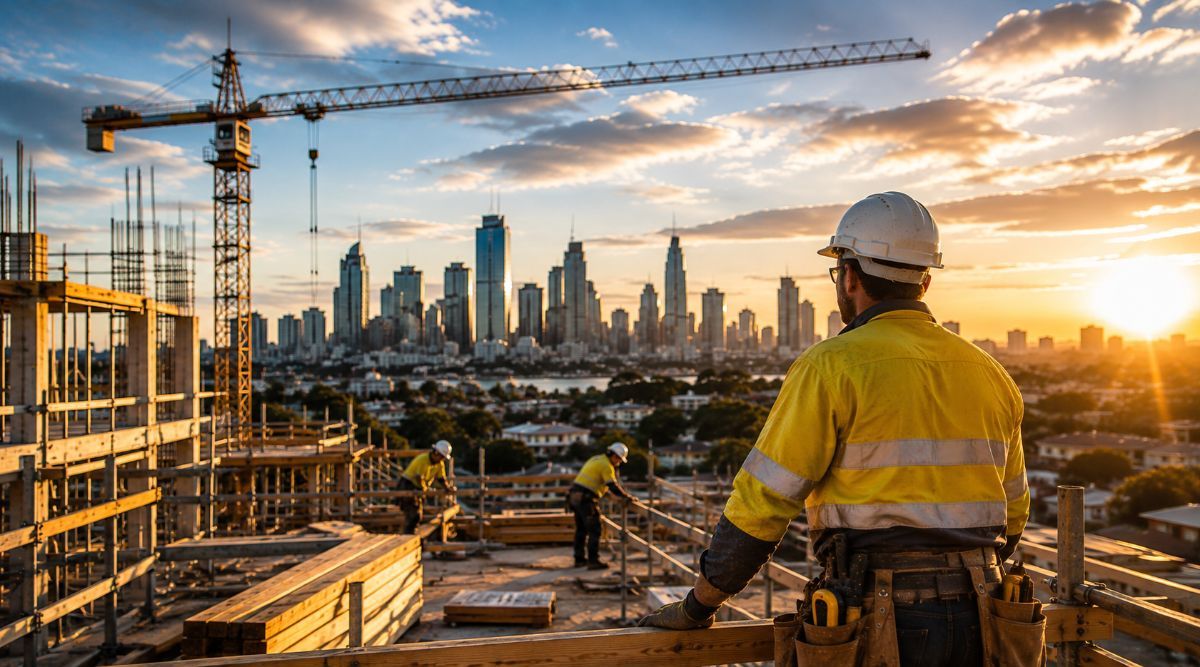
If you're job hunting in construction right now, there's a detail in the latest industry data that's easy to miss but genuinely important: the risk in this market isn't finding a job — it's finding one that lasts. With tens of thousands of construction businesses closing every year, where and who you work for matters just as much as the role itself.
Plenty of Jobs, But a Shaky Foundation
New analysis from Primara Research, prepared for OurTop10, shows more than 67,000 construction businesses shut down last year alone — the fourth year running above 64,000 closures. Nationally, 7,779 developers have gone under in the past two years, with over 3,000 of those in NSW.
Here's the number that matters most if you're weighing up job offers: almost half of all construction businesses that open their doors won't make it past three years. Primara's CEO Simon Ma summed up the risk facing anyone tied to a long-running project — signing on with a business today means trusting it will still be around, and financially healthy, by the time a multi-year build wraps up.
For job seekers, that's not just a stat about "the industry." It's a practical reason to look past the job title and pay rate, and ask a few sharper questions before accepting an offer.
Why the Job Market Doesn't Feel as Simple as "More Homes, More Work"
It would be reasonable to assume that record demand for housing means job security. To an extent, that's true — dwellings under construction hit 244,000 in the March 2026 quarter, the highest figure since records began in 1984, and Housing Minister Claire O'Neil has pointed to faster delivery and more approvals as signs of progress.
But industry confidence tells a different story. Sentiment dropped 17 per cent between 2025 and 2026 according to Kennards Hire's latest White Paper, with financing costs, interest rates, and labour shortages cited among the top concerns for the years ahead. In other words: there's no shortage of projects to work on, but there is real uncertainty about which employers will still be standing to see those projects through.
What This Means If You're Currently Job Hunting
A few practical takeaways for anyone applying to construction roles right now:
1) Ask about the pipeline, not just the current project. A business with one contract on the books is a very different bet than one with a visible pipeline of upcoming work. Kennards Hire's Tom Kimber noted that visibility over the project pipeline is exactly what gives businesses — and by extension, their employees — confidence to plan ahead.
2) Longer builds carry more employer risk. If you're being offered a role on a multi-year apartment project, it's worth asking how the business is placed financially, and whether it's part of a larger group or a standalone operation. Warranty and completion risk sits with the business — but job security sits with you.
3) High-demand trades still have leverage. Labour shortages remain one of the most consistently cited pressures facing the industry, which means skilled trades — carpentry, electrical, civil works, site supervision — are in a strong negotiating position even as overall business numbers shrink. Scarcity of workers in these roles can translate into better pay, more flexibility, and more job offers to choose between.
4) Bigger or more established employers aren't automatically safer, but they're worth a closer look. With survival rates at their lowest since 2011-2012, doing basic due diligence — checking how long a business has operated, its project history, and its reputation — is a reasonable step before committing to a role, especially for longer-term positions.
The Bigger Picture
The National Housing Accord's target of 1.2 million new homes by 2029 has already slipped in projections, now expected closer to December 2030 nationally and March 2032 in NSW. That slower timeline is partly a function of the same instability affecting job seekers — businesses closing before projects finish, and new ones opening into one of the toughest survival environments the sector has seen in over a decade.
The upside for workers is that this isn't a market short on opportunity. It's a market where being selective about who you work for is arguably more important than it's been in years.